Alaska Bear Viewing: Where to Go, When, and What Trips Cost
By the Outdoors Haven editors 9 min read Updated October 6, 2026
What changed: Expanded in October 2026 and re-checked against official sources such as the NPS, state agencies and manufacturers.
Pack this into your head
- Brooks Falls is best in July and September; August is often quiet
- Coastal Katmai and Lake Clark trips fly from Homer and Anchorage, mid-June to early September
- McNeil River access is by ADF&G lottery, applications due March 1
- Anan offers only 12 independent day passes per day in peak season
- Day trips run roughly $1,000 to $1,600 per person in 2026
- Katmai requires staying at least 50 yards from bears
- Weather grounds floatplanes often, so build in spare days
On this route
The best Alaska bear viewing is at Brooks Falls in Katmai National Park in July and September, on the wild coasts of Katmai and Lake Clark from mid-June to early September, at Anan Creek and Pack Creek in Southeast Alaska from July into late August, and at McNeil River State Game Sanctuary for the few who win its permit lottery. Almost every trip involves a small plane, and fly-out day trips from Homer or Anchorage commonly cost about $1,000 to $1,600 per person as of 2026.
Watching brown bears fish for salmon is one of the great wildlife experiences anywhere, and more accessible than many people assume. It is also expensive, seasonal and at the mercy of the weather. Planning comes down to four choices: where, when, how you get there, and whether a day trip is enough.
The main bear viewing areas at a glance
| Area | Bears | Best time | Access | Permit or limit |
|---|---|---|---|---|
| Brooks Falls, Katmai National Park | Brown | July and September | Fly Anchorage to King Salmon, then floatplane; or day tour from Anchorage | No viewing permit; bear school on arrival; platform time limits when busy |
| Katmai coast (Hallo Bay and other sites) | Brown | June to early September | Fly-in day trips, mostly from Homer and Kodiak | Through authorized operators |
| Lake Clark coast (Silver Salmon Creek, Chinitna Bay) | Brown | Mid-June to early September | Small plane from Anchorage, Homer or the Kenai Peninsula | No NPS entrance fee; guides or air taxi |
| McNeil River State Game Sanctuary | Brown | June to mid-August | Floatplane, about 100 air miles west of Homer | ADF&G lottery; 4-day permits; 10 people at the falls |
| Anan Wildlife Observatory, Tongass National Forest | Black and brown | July 5 to August 25 | Boat or floatplane from Wrangell, roughly 30 to 35 miles | Day pass required in peak season |
| Pack Creek, Admiralty Island | Brown | Mid-July to mid-August | Floatplane about 30 minutes from Juneau, or boat | Permit June 1 to September 10; 24 people a day in peak |
Katmai and Brooks Falls
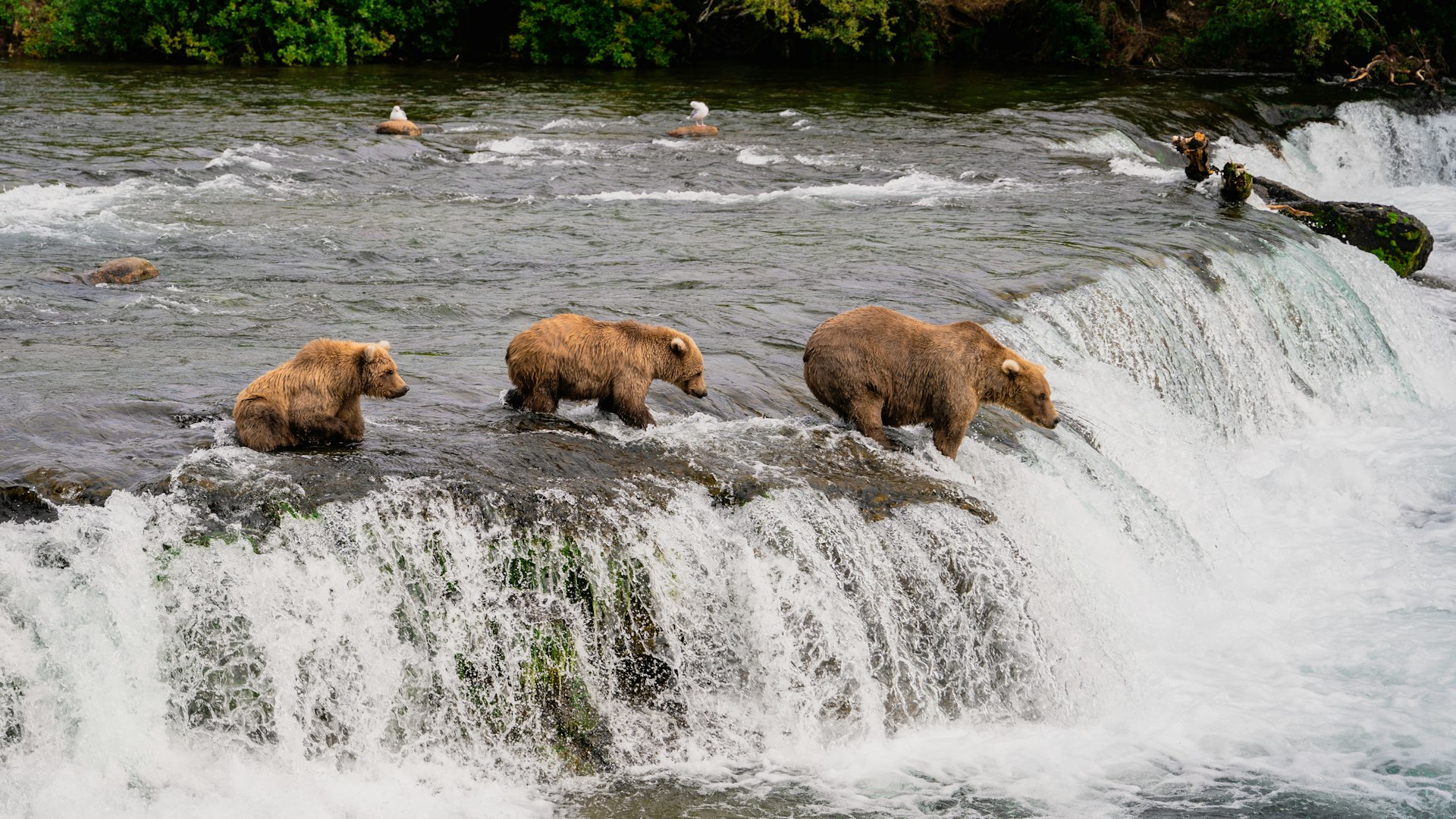
Brooks Falls is the famous image: big brown bears standing at the lip of a low waterfall, catching sockeye salmon as they jump. The NPS Brooks Camp bear viewing guide says viewing is best in July and September. Salmon start arriving in late June, mid-July usually brings the largest number of bears to the river, and the largest, most dominant bears hold the best spots at the falls.
August is the trap many first-timers fall into. The salmon have spread out to spawn and are hard to catch, almost all the bears leave, and the park notes there are typically days in August when no bears are seen at Brooks Camp. By September they return in high numbers, fatter and with new coats, to feed on dead and dying salmon, mostly in the lower river.
Practical details:
- Season: NPS and concessioner services run June 1 to September 17.
- Getting there: most visitors fly Anchorage to King Salmon, a little over an hour, then take a floatplane of about 20 minutes to Brooks Camp. Some operators sell complete day tours from Anchorage.
- Bear school: everyone checks in at the visitor center for a short orientation and safety talk before going anywhere.
- Platforms: four viewing platforms line the river, one at the falls, one at the riffles downstream, and two at the river mouth by the bridge. Rangers limit time on the Falls Platform when it is busy, and July is the most crowded month.
- Distance: Katmai requires visitors to stay at least 50 yards from any bear.
- Fishing: anyone fishing or wading in the Brooks River corridor needs a free permit through Recreation.gov, which carries a $6 booking fee; the platforms, trails and boardwalks are excluded. Anglers also need an Alaska sport fishing license, explained in our guide to US fishing licenses.
If you cannot go, Katmai’s Brooks Falls bearcam streams the falls through the season.
The Katmai and Lake Clark coasts
The Pacific coast of Katmai holds some of the highest densities of bears in the park, and Lake Clark’s Cook Inlet coast is just to the north. Trips here are different from Brooks: no platforms or boardwalks, small groups walking with a guide along beaches and sedge meadows, and bears that are often grazing or digging clams rather than fishing.
The NPS guide to fly-in bear viewing on the West Cook Inlet coast puts the season at mid-June to the beginning of September. Lake Clark charges no entrance fee, but there is no road, so everyone arrives by small plane with an air taxi or guide. Chinitna Bay can show as many as 20 brown bears from a single spot, and Silver Salmon Creek pairs bear viewing with sport fishing. Early in summer bears graze protein-rich sedges in the salt marshes; as salmon run later in the season, they move to the streams.
Hallo Bay and other sites on the Katmai coast follow a similar pattern and are reached mostly from Homer and Kodiak. Planes land on beaches or tidal flats, so tides and weather decide timing, and a trip can be moved or cancelled on the morning itself.
McNeil River: the permit lottery
McNeil River State Game Sanctuary, run by the Alaska Department of Fish and Game, has one of the largest seasonal gatherings of brown bears anywhere. The state reports as many as 144 individual bears seen over a summer and up to 74 at once. Access is tightly limited: no more than 10 visitors at McNeil River Falls at a time between June 7 and August 25.
The ADF&G permit program works like this as of 2026:
- Applications open in early March of the year before your visit and close March 1 of the viewing year.
- The lottery application fee is $30 per person.
- 185 guided viewing permits are issued, each for a 4-day block. Winners pay $225 if they are Alaska residents or $525 if not.
- 57 camp-standby permits, at $112 resident or $262 nonresident, let you camp and fill guided spots when permit holders do not show.
- You camp in the sanctuary campground and arrange your own floatplane, roughly 100 air miles west of Homer.
In June a smaller number of bears gathers at Mikfik Creek; the peak at the falls comes from July into mid-August with the chum salmon run.
Southeast Alaska: Anan Creek and Pack Creek
Anan Wildlife Observatory, in the Tongass National Forest south of Wrangell, is one of the few places where black and brown bears feed in the same creek at the same time. Recreation.gov lists a pink salmon run of some 200,000 to 300,000 fish a year. A half-mile boardwalk trail with stairs leads to a covered viewing platform and photo blind near the falls.
According to the Anan permit page on Recreation.gov, day passes are required from July 5 to August 25, visiting hours are 8 a.m. to 6 p.m., and only 12 independent visitors a day can buy passes, which go on sale February 1 and often sell out. Most people go with an authorized guide company, which includes the pass in the trip, and should not buy one separately.
Pack Creek, on Admiralty Island south of Juneau, is co-managed by ADF&G and the Forest Service. The ADF&G Pack Creek page says a permit is required from June 1 to September 10, peak-season visits from July 5 to August 25 are capped at 24 people a day, and more than 95 percent of visitors see at least one bear. Viewing happens from a viewing spit and an observation tower, with rangers on site to brief visitors. Floatplanes from Juneau take about 30 minutes, and you step off into shallow water, so rubber boots are essential.
Southeast Alaska is also where many cruise itineraries stop. Our comparison of expedition cruises for first-timers covers how small-ship trips handle wildlife landings.
When to go, month by month
| Month | What bears are doing | Where to go |
|---|---|---|
| June | Grazing sedge meadows and digging clams on the coast | Lake Clark and Katmai coast; McNeil (Mikfik Creek) |
| July | Salmon runs begin; bears gather at falls and river mouths | Brooks Falls (mid-July peak), McNeil, Anan, Pack Creek |
| August | Fishing streams in Southeast and on the coast; Brooks often quiet | Anan, Pack Creek, coastal streams, McNeil until mid-month |
| September | Feeding heavily before winter on spawned-out salmon | Brooks Camp lower river, coastal streams until early September |
Each site has its own rhythm and runs vary year to year. Ask your operator what the last few seasons looked like for the specific week you are considering.
What bear viewing trips cost, and day trip or lodge
As of 2026, operators in Homer commonly list fly-out day trips to the Katmai or Lake Clark coast at about $1,000 to $1,300 per person, with a few hours on the ground. A complete day tour from Anchorage to Brooks Falls runs around $1,500. Prices depend on the departure town, flight time, group size and whether park fees are included.
Lodges in or near the parks let you stay for several days. They cost far more, but give you more time with the bears, more chances when weather cancels a flight, and early morning and evening viewing when day visitors are gone. At Brooks Camp, the concessioner-run Brooks Lodge and the NPS campground are the two places to stay, and both can fill far ahead of the season.
Whichever you choose, keep a spare day. The NPS advises leaving extra time on each side of a Lake Clark trip because weather delays are likely, and the Brooks guide notes that weather and bears on the beach can delay floatplanes in both directions. Do not book a fly-out trip on the morning of your flight home.
Watching bears safely
Viewing areas work because the bears are well fed and used to people behaving predictably. Your job is to stay predictable:
- Stay with your group and your guide. The NPS asks viewing groups to stay within a few arms’ lengths of one another.
- Keep the required distance, at least 50 yards at Katmai, and give a mother with cubs extra room.
- Never carry food away from designated eating areas, and never leave a pack unattended.
- Speak calmly, never run, and give bears the right of way on trails and beaches.
- Follow ranger and guide instructions immediately, even when the bear seems relaxed.
A reputable operator does all of this without being asked. If one encourages you to get closer for a photograph, choose another operator next time. For hiking in bear country on your own, our guide to how to use bear spray covers carrying and using it.
What to bring
Expect wind, rain, cool temperatures and biting insects even in July. Pack waterproof jacket and pants, a warm insulating layer, a hat and gloves, insect repellent and a head net, and binoculars. Knee-high rubber boots are standard for coastal landings and Pack Creek; many operators provide them, so ask. Our guide to layering clothes for hiking works for a wet Alaska beach as well as a trail.
Small planes have tight weight limits for bags, often listed per person, so check before you pack a big camera bag. A long lens helps, but plan to put the camera down for part of the visit; a few hours pass quickly behind a viewfinder. Book the trip first, then build the rest of the itinerary around the spare day, not the other way around.
Questions people ask
When is the best time to see bears at Brooks Falls?
The National Park Service says bear viewing at Brooks Camp is best in July and September. Mid-July usually brings the most bears to the falls as sockeye salmon jump. In August the salmon spread out to spawn and most bears leave, so some days see none. In September bears return in high numbers to feed on dead and dying salmon in the lower river.
How much does a bear viewing trip in Alaska cost?
As of 2026, fly-out day trips from Homer to the Katmai or Lake Clark coast are commonly listed at about $1,000 to $1,300 per person, and day tours from Anchorage to Brooks Falls around $1,500. Multi-day lodge stays cost considerably more. McNeil River permits cost $225 for Alaska residents and $525 for nonresidents, plus a $30 lottery fee and transport.
Is Alaska bear viewing safe?
At established viewing areas with rangers or a reputable guide, the risk is low. These bears are focused on food and used to people behaving predictably. Stay with your group, keep the distance the area requires, which is at least 50 yards at Katmai, never carry food away from designated areas, speak calmly and never run. A guide who pushes closer for photos is a reason to choose another operator.
Can you see both black and brown bears in Alaska?
Yes. Anan Creek near Wrangell in Southeast Alaska is one of the few places where black and brown bears feed in the same creek at the same time, drawn by a pink salmon run. Black bears tend to fish near the falls, with brown bears more often farther up or down the creek. The coastal parks such as Katmai and Lake Clark are mainly brown bear viewing.
How do you get to Brooks Falls?
Most visitors fly from Anchorage to King Salmon on a scheduled flight of a little over an hour, then take a floatplane to Brooks Camp of about 20 minutes. Some operators run complete day tours from Anchorage. Everyone attends a short bear school orientation on arrival. Services run from June 1 to September 17, and weather can delay flights in either direction.
What is Hallo Bay bear viewing?
Hallo Bay is one of the coastal sites on the Katmai National Park shoreline used by fly-in bear viewing operators, mostly from Homer and Kodiak. Like the rest of the coast, it is known for brown bears grazing sedge meadows and digging clams in early summer, then fishing streams later. Trips land on beaches or tidal flats, so tides and weather shape the schedule.
Keep going
Next on the trail
Expedition Cruises for First-Timers: Antarctica, the Arctic and the Galápagos Compared
For a first expedition cruise, the Galápagos is the easiest start: warm, short flights, calm seas and about $4,500 to $12,000 per…
Oct 6, 2026 · 8 min
How to Use Bear Spray: When to Fire, How to Aim and What Comes After
To use bear spray, carry it in a hip or chest holster, never in your pack. If a bear charges and is…
Sep 29, 2026 · 8 min
How to Choose a Canoe Paddle: Length, Bent vs Straight Shaft, Blades and Materials
To choose a canoe paddle, size it by your seated torso, not your height: sit on a flat chair and measure from…
Oct 13, 2026 · 8 min