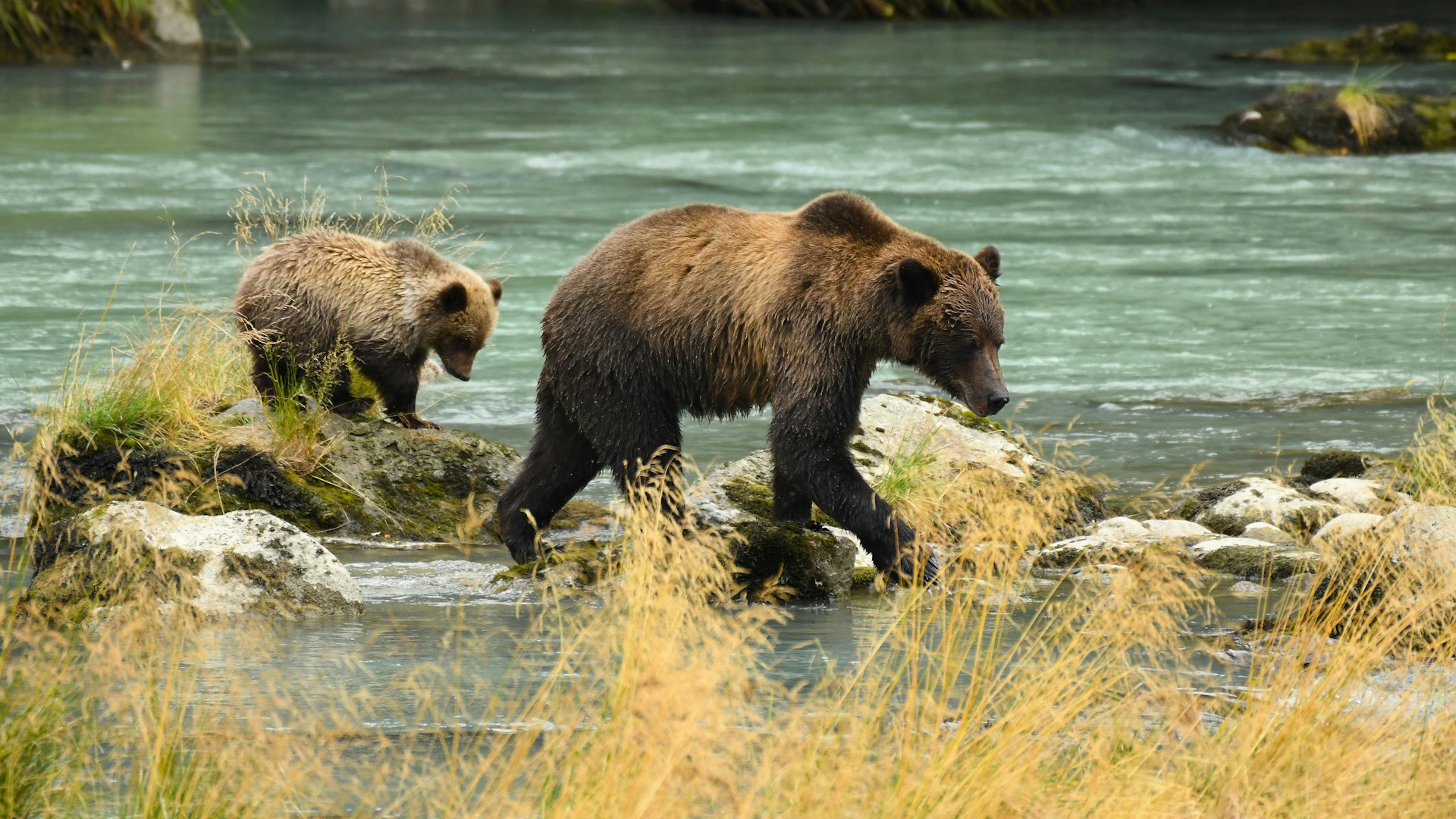
How to Use Bear Spray: When to Fire, How to Aim and What Comes After
By the Outdoors Haven editors 8 min read Updated September 29, 2026
Pack this into your head
- Buy an EPA-registered spray of at least 7.9 ounces with 1 to 2 percent capsaicinoids.
- Carry it in a hip or chest holster, never inside your pack.
- The NPS says to spray when a charging bear is within 60 feet.
- Aim slightly downward so the cloud rises into the bear's face.
- Bear spray is banned on all airline flights and in Yosemite.
- It works on black and grizzly bears, but the attack response differs.
On this route
- What bear spray is and how to choose a can
- Where to carry it
- How to use bear spray, step by step
- Wind, rain and cold
- Black bears and grizzlies behave differently
- Where you can and can't carry it
- The spray is the backup; avoiding encounters is the plan
- Plan the trip around the bear country you're entering
To use bear spray, carry it in a holster on your hip or chest where you can reach it in two seconds. If a bear charges and gets within about 60 feet, pull the can, flip off the safety clip with your thumb, point it slightly downward toward the bear and fire short bursts to build a cloud between you and the animal. Be ready to spray again if it keeps coming. When the bear stops or turns away, leave the area at a walk, never a run.
That’s the whole technique, and it takes about three seconds from holster to spray. The hard parts are everything around it: buying the right can, having it on your body instead of in your pack, knowing when a bear is a threat and when it’s just a bear, and keeping bears away from you in the first place. This guide follows the advice of the National Park Service and the Interagency Grizzly Bear Committee.
What bear spray is and how to choose a can
Bear spray is a pressurized can of oleoresin capsicum, the same hot pepper extract used in personal pepper spray, but much larger and designed to throw a wide cloud rather than a narrow stream. It inflames the bear’s eyes, nose and lungs for long enough to make it break off an attack. It doesn’t cause lasting harm, which is one reason agencies prefer it to firearms.
The Interagency Grizzly Bear Committee (IGBC) recommends buying only spray that meets these criteria:
- EPA registered. The registration number is printed on the front label. Personal pepper spray and dog spray are not the same product and don’t qualify.
- At least 7.9 ounces (225 grams) net weight.
- 1 to 2 percent capsaicin and related capsaicinoids, the EPA range for bear deterrents.
- A minimum range of 25 feet and a spray time of at least 6 seconds.
Popular cans run from about 7.9 to 10.2 ounces. The bigger cans spray longer, which matters if a bear charges more than once or you’re in a group. Expect to pay roughly $40 to $60 per can in 2026 at outdoor retailers and park-area stores. Near busy parks you can rent instead: at Canyon Village in Yellowstone, for example, a rental kiosk run by Bear Aware rents spray with a holster by the day in summer.
Where to carry it
The NPS is blunt about this: carry bear spray on a belt or chest holster at all times, and never keep it in your backpack. A bear at a full run covers ground far faster than you can take off a pack and dig through it. Surprise encounters happen at close range, on blind corners and near noisy creeks, so you need the can in your hand before you’ve finished processing what you’re seeing.
- Wear the holster on the side of your dominant hand, or on a chest strap if a hip belt covers your waist.
- In camp, keep one can in the tent next to your headlamp and another in the cooking area.
- On a bike, keep it on your body, not on the frame. A fall can separate you from the bike.
- Every person in the group should carry their own can. One can in the leader’s holster doesn’t help the person at the back.
How to use bear spray, step by step
- Stay still and assess. Most bears are not a threat. Talk calmly so the bear knows you’re human, and don’t run. Running can trigger a chase.
- Draw early. If the bear is approaching or acting agitated (huffing, jaw popping, swatting the ground, ears back), take the can out of the holster and remove the safety clip. The NPS suggests doing this before the bear is close so you’re not fumbling at the last moment.
- Hold it with both hands. One hand on the can, the thumb of the other on the trigger, index finger through the handle loop.
- Aim low. Point the nozzle slightly downward, toward the ground in front of the bear. The spray rises and spreads into a cloud, so aiming at the head from a distance often sends it over the bear.
- Fire when the bear is within about 60 feet. That’s the NPS threshold for a charging bear. Use short bursts of 1 to 2 seconds, sweeping slightly side to side to make a wall of spray. The bear has to run through it to reach you.
- Keep spraying if it keeps coming. Adjust your aim toward its face at close range. Save some spray if you can, since bears sometimes make a second approach.
- Leave. Once the bear stops or turns away, back off and leave the area at a steady walk. Don’t follow it to see where it went.
Practice with an inert training can, which the NPS recommends. The skill that matters is drawing from the holster and pulling the safety clip without looking. Most people who have never practiced struggle with the safety under stress.
Wind, rain and cold
Bear spray leaves the can fast, which helps it cut through a breeze, but wind still matters. The NPS notes that strong wind changes the spray’s direction and distance, and that snow, rain and cold weather shorten the range. Cold also lowers the pressure in the can.
- If you have any choice, position yourself so the wind is at your back or from the side.
- In a headwind, wait until the bear is closer before firing and aim lower.
- In freezing weather, carry the can inside your jacket or close to your body so it stays warm.
- If you get spray in your own eyes, move out of the cloud and flush with cool water. It hurts badly but passes.
Black bears and grizzlies behave differently
Bear spray works on all North American bears. What changes is the situation leading up to the spray and what you do if a bear makes contact anyway. Color is a poor guide: black bears can be brown, cinnamon or blond, and grizzlies can look nearly black. Look for a shoulder hump, a dished face and short, rounded ears on a grizzly, versus a straight face profile, taller ears and no hump on a black bear.
| Grizzly (brown) bear | Black bear | |
|---|---|---|
| Where in the Lower 48 | Greater Yellowstone, Glacier and northern Rockies, parts of Washington and Idaho | Most forested regions, from the Smokies and Shenandoah to Yosemite and the Adirondacks |
| Typical attack cause | Defensive: surprised at close range, protecting cubs or a carcass | Rare; often food-conditioned bears in campgrounds |
| If spray fails and it makes contact | Defensive attack: play dead, flat on your stomach, hands behind your neck, pack on | Do not play dead; fight back, aiming at the face and muzzle |
| If it attacks in your tent or stalks you | Fight back | Fight back |
The NPS guidance on staying safe around bears says that if a defensive grizzly attack continues for a long time after you play dead, fight back. Any bear that approaches steadily, follows you, or enters your tent is treated as predatory, and you fight with everything you have.
Where you can and can’t carry it
Bear spray is legal to carry in most national parks and national forests in bear country, and Yellowstone, Grand Teton and Glacier actively encourage it. But not everywhere allows it. Yosemite prohibits bear spray and other pepper spray; rangers there want visitors to yell and scare away the park’s black bears instead. Check the park’s regulations before you go.
You cannot fly with bear spray. The TSA bans it in both carry-on and checked bags. Buy or rent it near your destination. Some park-area stores and regional airports have bins where departing visitors leave unused cans. Canada has its own rules on cross-border transport, so check with the border agency if driving north.
Store the can out of direct sun and never in a closed car on a hot day. Heat can damage the can or make it vent, and a discharge inside a vehicle is miserable to clean up.
The spray is the backup; avoiding encounters is the plan
Most bear encounters end without anyone reaching for a can, because people did the basics right. The NPS recommends these:
- Make noise. Talk, clap or call out “hey bear,” especially near loud streams, in thick brush and on blind corners. Bear bells don’t work well.
- Hike in groups. Larger groups are louder and more intimidating. Yellowstone recommends groups of three or more in bear country.
- Keep your distance. Yellowstone requires you to stay at least 100 yards from bears. If you see one, give it room and go around or turn back.
- Avoid carcasses. If you smell something dead or see birds circling, leave. Grizzlies defend food aggressively.
- Don’t drop your pack during an encounter. It protects your back and keeps food away from the bear.
Food storage in bear country
A bear that gets human food once tends to come back, and those bears are often euthanized. Store everything with a scent, including toothpaste and trash, so bears can’t reach it. In developed campgrounds, that means the metal food locker or a hard-sided vehicle where allowed. In the backcountry, the Yellowstone backcountry rules require hanging food at least 10 feet off the ground and 4 feet from the trunk on the provided poles, or using an IGBC-approved bear-resistant container. Sleep at least 100 yards from where you cook, preferably upwind. Many areas, such as parts of the Sierra Nevada and Denali, require a hard-sided bear canister, and ranger stations often loan them.
Cook and eat away from your tent, and never keep food, snacks or scented items inside it. Our guide to campfire cooking basics covers setting up a kitchen area, and how to choose a tent helps if you’re buying gear for a first trip.
Plan the trip around the bear country you’re entering
Bear spray belongs on the list next to water, layers and a first aid kit whenever you hike in grizzly range, and it’s cheap insurance in black bear country where it’s allowed. Our checklist of what to pack for a day hike covers the rest. If you want to see bears on purpose, from a safe platform or with a guide, the Alaska bear viewing guide explains how those trips work. And when you’re near wildlife, the Leave No Trace principles on respecting animals keep both you and the bears safer.
The single habit that makes the biggest difference: put the holster on at the trailhead, before you lock the car, and take it off only in camp. A can in the car or at the bottom of the pack is the same as having no can at all.
Questions people ask
How far does bear spray shoot?
Most bear sprays reach 25 to 30 feet, and the Interagency Grizzly Bear Committee sets 25 feet as the minimum range for an acceptable product. A full can empties in roughly 6 to 9 seconds depending on the brand. Wind, rain, snow and cold all shorten the effective range, which is why the NPS advises firing when a charging bear is within about 60 feet: the cloud needs a moment to form.
Does bear spray work on black bears?
Yes. Wildlife agencies say bear spray is effective on all North American bear species, including black bears, grizzlies and polar bears. What changes is what you do if spray fails and a bear makes contact. With a defensive grizzly you play dead; with a black bear you fight back. Yosemite is an exception on carrying: bear spray is not permitted there, and rangers ask visitors to yell and scare black bears away instead.
Can you bring bear spray on a plane?
No. The TSA prohibits bear spray in both carry-on and checked bags, because standard cans are far larger than the 4-ounce limit for self-defense sprays and contain a pressurized irritant. Buy a can when you arrive, or rent one near parks such as Yellowstone and Glacier, and leave it at a donation or recycling bin when you fly home. Never try to sneak it into luggage.
Does bear spray expire?
Yes. Every can has an expiration date printed on it, usually a few years after manufacture, and the propellant loses pressure over time. An expired can may spray a weaker or shorter stream. Check the date before each season, replace expired cans, and use the old one for practice in an open area far from people. Never leave any can in a hot car, which can damage it or cause it to vent.
Is bear spray better than a gun?
The National Park Service recommends bear spray over firearms for most visitors. Spray is easy to use without much training, creates a wide cloud that doesn't require precise aim, and doesn't risk wounding a bear, which can make an encounter more dangerous. The IGBC cites Alaska research in which spray stopped undesirable bear behavior more than 90 percent of the time.
Keep going
Next on the trail
How to Choose a Canoe Paddle: Length, Bent vs Straight Shaft, Blades and Materials
To choose a canoe paddle, size it by your seated torso, not your height: sit on a flat chair and measure from…
Oct 13, 2026 · 8 min
Alaska Bear Viewing: Where to Go, When, and What Trips Cost
The best Alaska bear viewing is at Brooks Falls in Katmai National Park in July and September, on the Lake Clark and…
Oct 6, 2026 · 9 min
Expedition Cruises for First-Timers: Antarctica, the Arctic and the Galápagos Compared
For a first expedition cruise, the Galápagos is the easiest start: warm, short flights, calm seas and about $4,500 to $12,000 per…
Oct 6, 2026 · 8 min