Winter Camping for Beginners: Managing Moisture, Not Cold
By the Outdoors Haven editors 7 min read Updated October 6, 2026
What changed: Expanded in October 2026 and re-checked against official sources such as the NPS, state agencies and manufacturers.
Pack this into your head
- Sweat soaks your layers and chills you later, so start walking slightly cold
- Carry dry sleep clothes that never come out during the day
- Combined pad R-value of 5.5 or more, usually foam under an inflatable
- Isobutane stops vaporizing near 11°F, so warm the canister or use liquid fuel
- Never cook or run a heater inside a closed tent; carbon monoxide kills
- Keep water bottles in your bag at night and stored upside down by day
- First trips belong within easy reach of a car or a heated building
On this route
Winter camping for beginners comes down to two things: staying dry and insulating what’s under you. Dress lightly while you move so sweat doesn’t soak your layers, change into dry clothes at camp, and sleep on pads with a combined R-value of about 5.5 or more under a bag whose comfort rating matches the night. Then keep water and fuel from freezing, never run a stove inside a closed tent, and make your first trip short and close to the car.
Cold itself is rarely what ruins a winter night. Moisture is: sweat in a base layer, frost inside a sleeping bag, condensation on the tent walls. Manage that, and winter camping is quiet, bug-free and beautiful. Ignore it, and no amount of expensive gear rescues the night.
Sweat is the problem, not cold
You’ll work hard hauling a pack or sled through snow, you’ll sweat, and then you’ll stop. That damp base layer now pulls heat out of you all evening, and it won’t dry in a freezing tent.
- Start the walk slightly cold. If you’re comfortable in the first ten minutes, you’re overdressed.
- Shed layers before you sweat, not after. Open zips on uphill stretches.
- Add layers the moment you stop, before you start to chill. A big insulated jacket goes on at every break and in camp.
- Keep a dedicated set of dry sleep clothes, including socks, that never comes out of the pack during the day.
Synthetic and wool layers keep insulating when damp; cotton doesn’t. The layering guide covers base, mid and shell layers in detail.
Sleeping warm: pads first, then the bag
Snow and frozen ground pull heat from you far faster than cold air, and your sleeping bag is crushed flat underneath you, insulating almost nothing. The pad does that work.
Aim for a combined R-value of about 5.5 or more. The classic setup is a closed-cell foam pad, around R 2, under an insulated inflatable of R 4 or higher; R-values of stacked pads roughly add up. The foam also means you’re not lying on snow if the air pad punctures, which eventually it will. The sleeping pad R-value guide explains the numbers.
For the bag, look at the comfort rating, not the limit rating in the product name, and pick one at or below the coldest expected low. A bag sold as 0°F typically has a comfort rating around 15°F; the sleeping bag temperature ratings guide explains the gap.
- Eat before bed. A substantial snack with some fat gives your body fuel to burn overnight.
- Use a hot water bottle. A sturdy, tightly sealed bottle of hot water at your feet or between your thighs lasts hours. Check the lid twice.
- Wear a warm hat and cinch the hood and draft collar.
- Breathe out of the bag. Breathing into it adds moisture that freezes in the insulation.
- Empty your bladder before sleeping, and consider a clearly marked pee bottle so you’re not tempted to wait for hours.
- Keep batteries warm. Phone, headlamp and camera batteries sleep in the bag with you.
Tents and campsites on snow
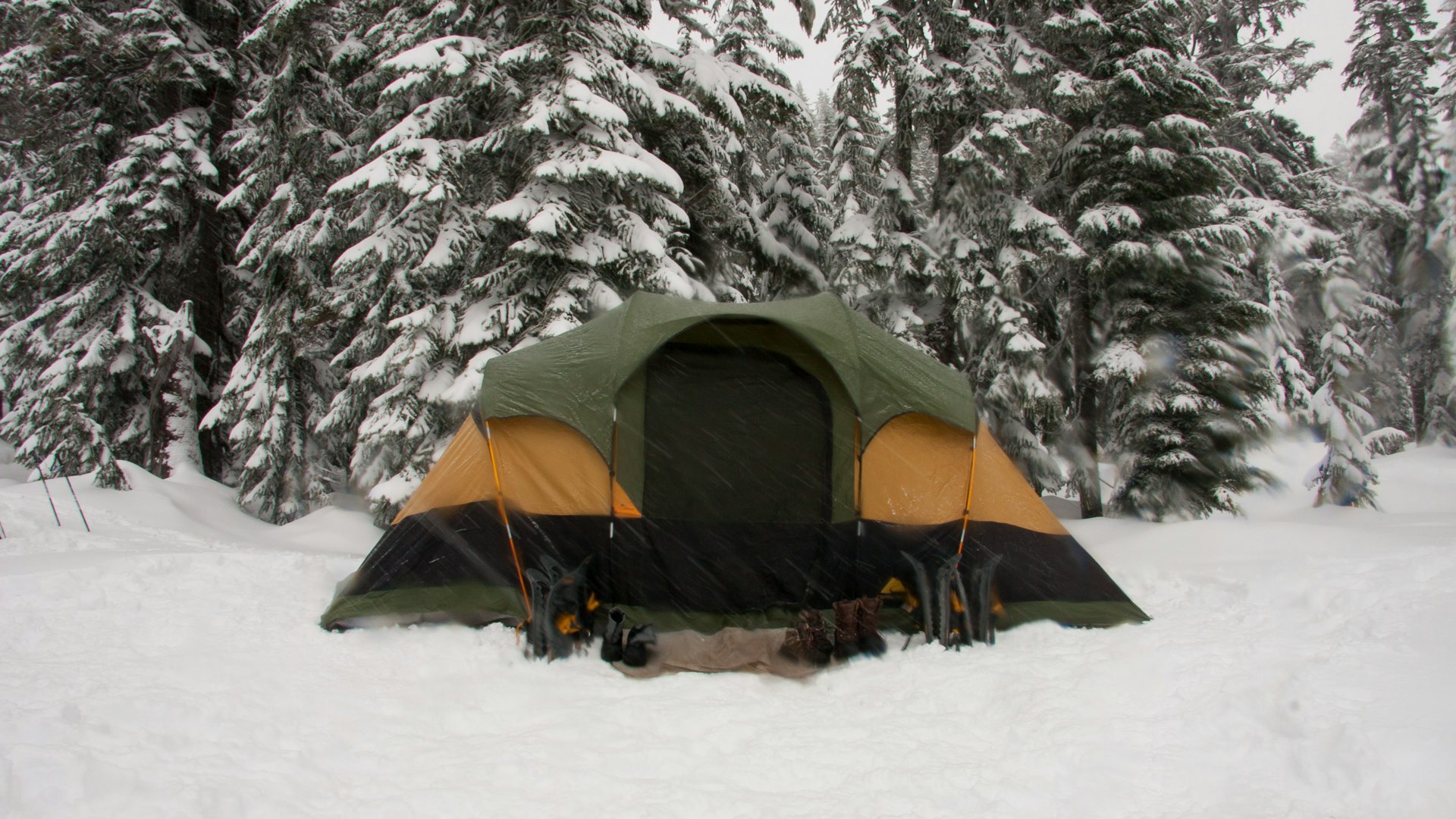
A sturdy three-season tent is often fine for a first trip in a sheltered, forested site with light snow and little wind. In open terrain, above treeline or when heavy snow or strong winds are forecast, use a four-season tent with stronger poles and less mesh. How to choose a tent explains what the season ratings really mean.
- Stamp out a platform with snowshoes or skis, larger than the tent, and let it set up for 20 to 30 minutes so it firms before you pitch.
- Anchor with snow stakes or “deadmen”: stuff sacks filled with snow, or sticks, buried sideways.
- Ventilate. Open vents even when it’s bitter. A sealed tent fills with frost that melts onto you in the morning.
- Look up and around. Avoid standing dead trees and branches loaded with snow, and stay clear of slopes that could slide. Check the regional avalanche forecast before any trip in the mountains.
- Brush snow off the fly during heavy snowfall so it doesn’t sag or collapse.
Park rules often change in winter. In Rocky Mountain National Park, for example, winter wilderness permits are first-come, first-served in person with a $10 administrative fee, campers must be on snow or rock and never on vegetation, at least 200 feet from water and at least a mile from the trailhead, and if a designated site has more than 4 inches of snow you camp at least 200 feet away from it. Fires are prohibited; portable stoves only. Those are good habits anywhere, and the Leave No Trace principles list snow as a durable surface.
What changes from summer gear
| Item | Typical summer setup | Beginner winter setup |
|---|---|---|
| Sleeping pad | R 2 to 4 | Combined R 5.5 or more (foam plus inflatable) |
| Sleeping bag | Comfort 40 to 50°F | Comfort at or below the forecast low, often a 0°F to 15°F bag |
| Stove fuel | Isobutane canister | Liquid fuel, or canister with regulator kept warm |
| Water treatment | Filter | Boiling or chemical treatment; filter kept from freezing |
| Footwear | Hiking shoes | Insulated waterproof boots, plus camp booties |
| Hands | Light gloves | Liner gloves plus mittens, with spares |
| Light | One headlamp | Headlamp plus spare batteries kept warm; nights run 14 to 15 hours |
Water and food in freezing weather
Water is the logistics problem nobody expects. Bottles freeze, filters crack, and melting snow uses far more fuel than heating liquid water.
- Store bottles upside down. Ice forms at the top first, so an inverted bottle still opens.
- Use insulated bottle sleeves by day, and wide-mouth bottles, which freeze shut less easily than narrow ones.
- Sleep with tomorrow’s water in your bag, in bottles you trust not to leak.
- Protect your filter. Many hollow-fiber filters can be damaged by freezing without any visible sign. Keep it in an inside pocket and in your bag at night, or switch to boiling or chemical treatment; the water purification guide compares methods.
- Melting snow? Start with a little liquid water in the pot so the snow doesn’t scorch, and budget generous extra fuel.
- Eat more and often. Cold-weather camping burns more energy. Pick foods that don’t freeze rock-hard, and keep snacks in an inside pocket.
Stoves in the cold, and carbon monoxide
Canister stoves lose pressure as they get cold. MSR explains that isobutane boils at about 11°F at sea level and propane at about -44°F; its IsoPro blend is mostly isobutane with propane added to help in the cold. Below freezing, the canister also chills itself as you use it.
- Keep the canister warm in your jacket or sleeping bag until you cook, and set it on a foam pad, not directly on snow.
- Use a stove with a pressure regulator, or a remote-canister stove that can run the canister inverted, which feeds liquid fuel to the burner.
- For real cold, a liquid fuel stove running white gas is the most dependable choice, which is why winter mountaineers still carry them.
Whatever stove you use, don’t cook in a closed tent and don’t bring a fuel-burning heater inside one. The CDC’s carbon monoxide guidance is blunt: never use a portable gas camp stove indoors. Carbon monoxide has no smell, and early symptoms such as headache, dizziness, weakness and nausea are easy to blame on altitude or tiredness. Cook in the open or in a well-ventilated vestibule with the door wide open, and never fall asleep with a stove running.
Hands, feet and frostbite
Hands and feet go first, often while the rest of you feels fine.
- Mittens are warmer than gloves because your fingers share heat. Wear thin liner gloves for fiddly tasks and mittens over them, and pack a spare set.
- Boots must fit with your thick socks. A boot that only fits once you jam thick socks in restricts circulation and makes feet colder. Insulated winter boots or boots with removable liners work best.
- Change into dry socks at camp and keep a pair just for sleeping.
- Vapor barrier socks, thin waterproof liners worn next to the skin, keep sweat out of boot insulation on multi-day trips. They feel clammy but work.
- Watch each other’s faces for white or waxy patches on cheeks, nose and ears, early signs of frostbite.
Persistent shivering, fumbling hands, slurred speech and poor decisions are early signs of hypothermia, in yourself or a partner. Learn them before the trip from the hypothermia guide, and act on them early.
Where and how to start
Your first winter night should be easy to abandon. Good options:
- A campground with winter sites or a state park that keeps a loop plowed, where your car is a few steps away.
- A short snowshoe or ski in, a mile or two on a trail you know, in a fair forecast.
- A night in the backyard, which tests your sleep system with zero risk.
Plan around the dark. In late December, much of the northern US gets only about 9 hours of daylight, so set up camp early and expect to spend 14 hours or more in or around the tent. Tell someone where you’re going and when you’ll be back, check the forecast the morning you leave, and set a firm turnaround time.
Bailing at 2 a.m. and driving home isn’t a failure. It’s a successful test: you found out what your gear really does at 10°F within walking distance of a heater rather than ten miles up a valley, which is exactly the point of a first trip.
Questions people ask
How cold is too cold to camp?
There's no single number. What matters is whether your insulation, especially your pad, matches the night, and whether you can stay dry. Beginners do best with first trips no colder than the teens to low 20s °F, close to a car. Experienced winter campers sleep well far below zero with the right system, and anyone can be miserable at 25°F without it.
Can you use a 3-season tent for winter camping?
Often, yes, in sheltered, forested sites with light snow and little wind. Expect it to be drafty through the mesh, and brush snow off the fly so it doesn't sag. In open terrain, above treeline, or when heavy snow or strong winds are forecast, a four-season tent with stronger poles and less mesh is the safer choice.
What R-value do I need for winter camping?
Most winter campers aim for a combined R-value of about 5.5 or more when sleeping on snow or frozen ground, often by stacking a closed-cell foam pad of around R 2 under an insulated air pad of R 4 or higher. The foam also keeps you off the snow if the air pad punctures. Cold sleepers should go higher.
Do canister stoves work in freezing temperatures?
They struggle. Isobutane, the main fuel in most canisters, boils at about 11°F at sea level, so as the canister cools it loses pressure and the flame weakens. Keeping the canister warm in your jacket or bag helps, as do stoves with pressure regulators or inverted-canister designs. For real cold, liquid fuel stoves running white gas are the most reliable.
How do you keep water from freezing when winter camping?
Sleep with the next day's water inside your sleeping bag in tightly sealed bottles, carry bottles in insulated sleeves during the day, and store them upside down so ice forms at the bottom instead of in the lid. Fill bottles with hot water at night. Keep water filters warm too, because a frozen filter can crack and stop protecting you.
Keep going
Next on the trail
Bear Canister Guide: Where They’re Required, Which Ones Count and How Much Food Fits
A bear canister is a hard-sided, lockable food container that bears can't open. It is required for backcountry camping in Yosemite, parts…
Oct 13, 2026 · 9 min
Hypothermia Signs and Prevention: The Umbles, Cold Water and What to Do
Hypothermia starts when your core temperature falls below 95°F. Early signs are strong shivering and the umbles: stumbling, mumbling, fumbling and grumbling,…
Sep 29, 2026 · 8 min
How to Choose a Canoe Paddle: Length, Bent vs Straight Shaft, Blades and Materials
To choose a canoe paddle, size it by your seated torso, not your height: sit on a flat chair and measure from…
Oct 13, 2026 · 8 min