Backpacking With Kids: Ages, Distances and How to Plan the First Overnight
By the Outdoors Haven editors 8 min read Updated October 13, 2026
Pack this into your head
- Keep the first overnight to one night and 1 to 3 miles each way.
- AAP guidance caps school backpacks at 15% of body weight; a good ceiling on trail too.
- Children's sleeping bags aren't covered by the ISO temperature rating standard.
- Teach Hug-a-Tree: if lost, stay in one place and blow a whistle.
- AAP: no oil of lemon eucalyptus repellent on children under 3.
- Pick camp for water, flat tent space and an easy bail-out, not for miles.
On this route
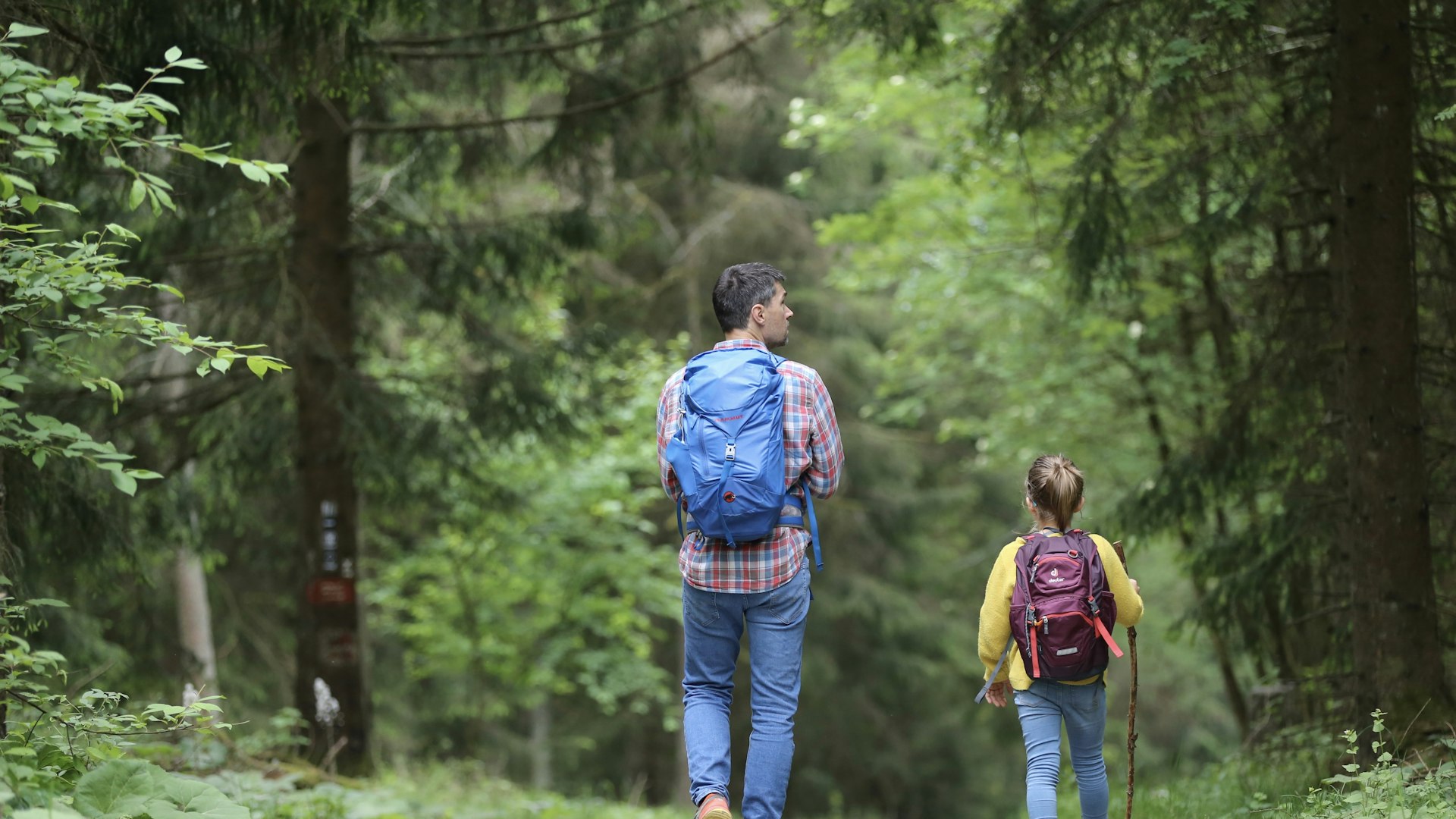
Backpacking with kids works best when the first trip is almost embarrassingly easy: one night, 1 to 3 miles from the trailhead, a campsite with water and rocks to climb, and adults carrying most of the gear. Children can start at any age, but the distance and what they carry change a lot between a toddler in a carrier and a 10-year-old with their own sleeping bag.
The trip succeeds or fails on the kids’ experience, not the mileage. A child who spends the afternoon building dams at a creek and eats hot chocolate in a tent will ask to go again. One who gets marched 6 miles in the rain won’t.
What age can kids start, and how far can they go?
No agency sets ages or distances for children, so treat the table below as a typical starting range, not a rule. The real test is a day hike: if your child can cover the planned distance and elevation on a day hike with energy left, they can do it with a light pack and a night out.
| Age | Typical one-way distance for a first trip | What the child carries | What to expect |
|---|---|---|---|
| Under 3 (in a carrier) | Up to about 1 mile | Nothing; one adult carries the child, the other carries almost everything | Naps drive the schedule; diapers and extra clothes take space |
| 3 to 5 | About 1 to 2 miles | A small pack with water, a snack and a jacket | Frequent stops; may need carrying for stretches |
| 6 to 9 | About 2 to 4 miles | Water, snacks, layers, headlamp, maybe a light sleeping bag | Motivated by goals: a lake, a bridge, a summit |
| 10 and up | About 4 to 8 miles | Own clothes and sleeping bag, some shared food | Can help with camp chores and route-finding |
Elevation gain and heat cut these numbers fast. Our guide on how far you can hike in a day explains how to add time for climbing, and the same logic applies to small legs, only more so.
Planning the first overnight
The National Park Service suggests two things families often skip: a backyard campout to give everyone a test run, and trying on gear such as backpacks and boots before the trip to make sure they fit. Both are worth doing. A night in the yard shows you whether your child sleeps in a tent, whether the sleeping bag is warm enough and what time everyone actually wakes up.
Then work through a short checklist:
- Pick one night. A second night is a different trip, with more food and more chances for weather to turn.
- Choose a good forecast. Rain on a first trip is the most common reason kids don’t want to go back. Be willing to postpone.
- Check permits and food rules. Many national parks require a wilderness permit for any overnight, and many require a bear canister. Our bear canister guide lists which parks require them and which lend them free.
- Arrive early. Reach camp by early afternoon so there’s daylight for setting up, exploring and dinner without rushing.
- Write down the plan. Leave your route, campsite and return time with someone at home.
Choosing a route kids will enjoy
Kids care about what’s at the end and what happens along the way. When you compare options, rank them like this:
- Water at camp. A lake or creek gives you a water source and hours of entertainment. Supervise closely near moving water, and treat everything you drink; our guide on how to purify water backpacking compares filters, tablets and boiling.
- Short, steady grades. A trail with modest climbing beats a shorter one that goes straight up. A topographic map shows you where the steep sections are before you commit.
- Flat, established tent sites. Designated backcountry sites or walk-in campgrounds remove guesswork and are easier on the land.
- An easy way out. A route you can reverse in under an hour means a sick child or a storm isn’t an emergency.
- Things to find. Bridges, boulders, a waterfall or a fire lookout make the miles go by.
Walk-in sites at state parks and national forest campgrounds are a good middle step between car camping and true backcountry. If your family isn’t ready for any of it yet, a guided ranch week is another way in; our look at family dude ranch vacations covers what those trips include.
Gear for kids, and what adults carry
The American Academy of Pediatrics’ backpack safety guidance says a school backpack shouldn’t weigh more than 15% of a child’s body weight, and it recommends using both shoulder straps and buckling the waist or chest strap. That’s school guidance, but it’s a reasonable ceiling on the trail: about 6 pounds for a 40-pound child, 9 pounds for a 60-pound child. Most kids under 8 should carry well under that.
| Item | Who carries it | What to look for |
|---|---|---|
| Small backpack | Child | Hip belt and sternum strap; fits their torso, not an adult’s hand-me-down |
| Water bottle and snacks | Child | Easy to reach without help |
| Rain jacket and warm layer | Child | Synthetic or wool, not cotton |
| Whistle and headlamp | Child | Whistle clipped to a shoulder strap; headlamp sized for a small head |
| Sleeping bag | Older child or adult | Kid-length bags waste less space and warm up faster |
| Sleeping pad | Older child or adult | Insulated; kids roll off pads, so a slightly wider one helps |
| Tent, stove, food, first aid, water treatment | Adults | Room in the tent for the whole family plus gear |
Sleeping bags need extra care. The ISO 23537 standard behind most adult temperature ratings does not apply to children’s bags, so a kid’s bag rating is the manufacturer’s own estimate. Choose a bag rated well below the expected low, and pair it with a warm pad; our guide to sleeping pad R-value explains how much insulation each season needs. Put kids to bed in dry clothes and a hat, and pack spare socks just for sleeping.
Footwear matters more than brand. Trail runners or light hiking shoes with good grip suit most kids; stiff boots usually aren’t needed. Bring sandals or water shoes for camp and creek play.
Food and water on the trail
Kids burn through snacks and stop eating when they’re tired, so plan on more frequent, smaller meals than adults need. Put a few snacks in the child’s own pack so they can eat without waiting for a stop, and use snacks as trail markers: “Next bridge, we have the gummy bears.”
- Bring familiar food. A first trip isn’t the time to test a freeze-dried meal on a picky eater. Pasta, tortillas with cheese, instant oatmeal and hot chocolate travel well.
- Offer water often. Children don’t always say they’re thirsty. Remind them to drink at every stop, and carry enough for the hike in plus a reserve.
- Plan for spills. Pack a spare dinner portion and extra hot drink packets.
- Store food properly. Snacks in kids’ pockets and packs are the easiest thing to forget at bedtime. Do a pocket check for wrappers before everyone gets in the tent.
Safety: getting lost, sun, bugs and first aid
The NPS teaches children a simple routine if they get separated, often called Hug-a-Tree. Its outdoor emergency plan tells kids to find a tree, hug it and stay put, and says a bench or big rock can stand in for the tree. The point is to stay in one place and make yourself big: blow a whistle, wave, and answer searchers who call your name. The NPS camping planning page adds that adults should also stay put if separated, unless there’s imminent danger, and recommends carrying whistles and using a buddy system.
Practice the routine before the trip, and keep young kids within sight on the trail. Let older kids lead to the next trail junction and wait there, rather than running ahead out of view.
For bugs, the AAP’s guide to choosing an insect repellent for children says 10% DEET protects for about 2 hours and 30% for about 5, and that you should not use oil of lemon eucalyptus or PMD products on children younger than 3. It recommends against combined sunscreen and repellent products, since sunscreen needs reapplying far more often. Apply repellent to your own hands and then to a child’s face, avoiding eyes, mouth and their hands. Use a broad-spectrum sunscreen and a sun hat, especially above treeline where shade disappears.
Carry a family-sized first aid kit with children’s doses of any medicines your pediatrician recommends, plus extra blister care. Know the signs of cold stress too. Smaller bodies cool faster, and a wet child in wind can get chilled on a summer evening; our guide to hypothermia signs and prevention lists the early warning signs.
Teaching Leave No Trace to kids
Children learn the seven principles faster by doing than by hearing them. The Leave No Trace Center’s own youth materials lean on games and short activities rather than lectures, and suggest focusing on two or three principles at a time with younger kids. On the trail, give them jobs that match a principle:
- Trash ranger: carries the trash bag and checks camp for micro-trash before you leave.
- Trail keeper: reminds the group to stay on the trail and walk through puddles, not around them.
- Wildlife watcher: spots animals from a distance and makes sure nobody feeds them.
- Treasure photographer: takes pictures of rocks, flowers and pinecones instead of taking them home.
Our explainer on the seven Leave No Trace principles has real trail examples you can turn into kid-sized jobs. Many national parks also run Junior Ranger programs, which give kids a booklet of activities and a badge, a good goal for the morning before you hike out.
When you get home, ask your kids what they liked best and plan the next trip around that answer. If it was the creek, find another creek. If it was the tent, go again soon while they still remember it.
Questions people ask
What age can kids start backpacking?
There's no minimum age. Families take babies and toddlers in carriers, but the adults then carry everything, so trips stay very short. Around ages 4 to 6 most children can walk a mile or two with a tiny pack, and by 8 to 10 many can hike several miles carrying their own clothes and snacks. Readiness matters more than age: can they hike your planned distance on a day hike without melting down?
How far can a child hike while backpacking?
Plan for less than they manage on a day hike, because camp chores and a pack slow everyone down. A rough starting point is 1 to 2 miles for preschoolers, 2 to 4 for early grade-schoolers and 4 to 8 for kids 10 and up, adjusted for elevation gain and heat. Test the distance on a day hike first.
How much weight should a child carry backpacking?
The American Academy of Pediatrics says a school backpack shouldn't exceed 15% of a child's body weight, and that's a sensible ceiling for a trail pack too. For a 60-pound child that's 9 pounds. Young kids often carry far less: water, a snack, a jacket and a whistle. Adults carry the shared gear.
What should kids carry in their backpack?
Their own water bottle, snacks, a warm layer and rain jacket, a hat, a headlamp, a whistle clipped to a strap, and one small comfort item. Older kids can add their sleeping bag or clothes. Keep first aid, the stove, food and water treatment in an adult's pack.
Is backpacking with a toddler a good idea?
It can work if you treat it as camping with a walk, not a hike with camping. One adult carries the child in a carrier and the other carries nearly all the gear, so pick a site a mile or less from the car with a flat, safe area. Expect frequent stops, plan naps around the hike and bring extra clothes.
Keep going
Next on the trail
How to Choose a Canoe Paddle: Length, Bent vs Straight Shaft, Blades and Materials
To choose a canoe paddle, size it by your seated torso, not your height: sit on a flat chair and measure from…
Oct 13, 2026 · 8 min
Hiking With Dogs: Where They’re Allowed, What to Carry and Staying Safe
You can hike with dogs on most national forest and BLM trails and in many state parks, but most national parks limit…
Sep 29, 2026 · 8 min
Family Dude Ranch Vacations: What a Week Really Costs and How to Pick the Right Ranch
A family dude ranch vacation usually means a week of all-inclusive lodging, meals and daily horseback riding. Rates published in 2026 run…
Oct 6, 2026 · 7 min