Canoe vs Kayak: Which to Choose for Your Trip, Skills and Gear
By the Outdoors Haven editors 7 min read Updated September 29, 2026
Pack this into your head
- Canoes use a single-blade paddle; kayaks use a double-blade paddle.
- Canoes carry more cargo and suit families, dogs and long lake trips with portages.
- Kayaks are faster, sit lower out of the wind, and are easier to paddle alone.
- Beginners learn kayak basics faster; canoe steering takes more practice.
- Federal rules require a USCG-approved wearable life jacket for everyone in either boat.
- In 2024, canoes and kayaks together accounted for about a fifth of US boating deaths.
On this route
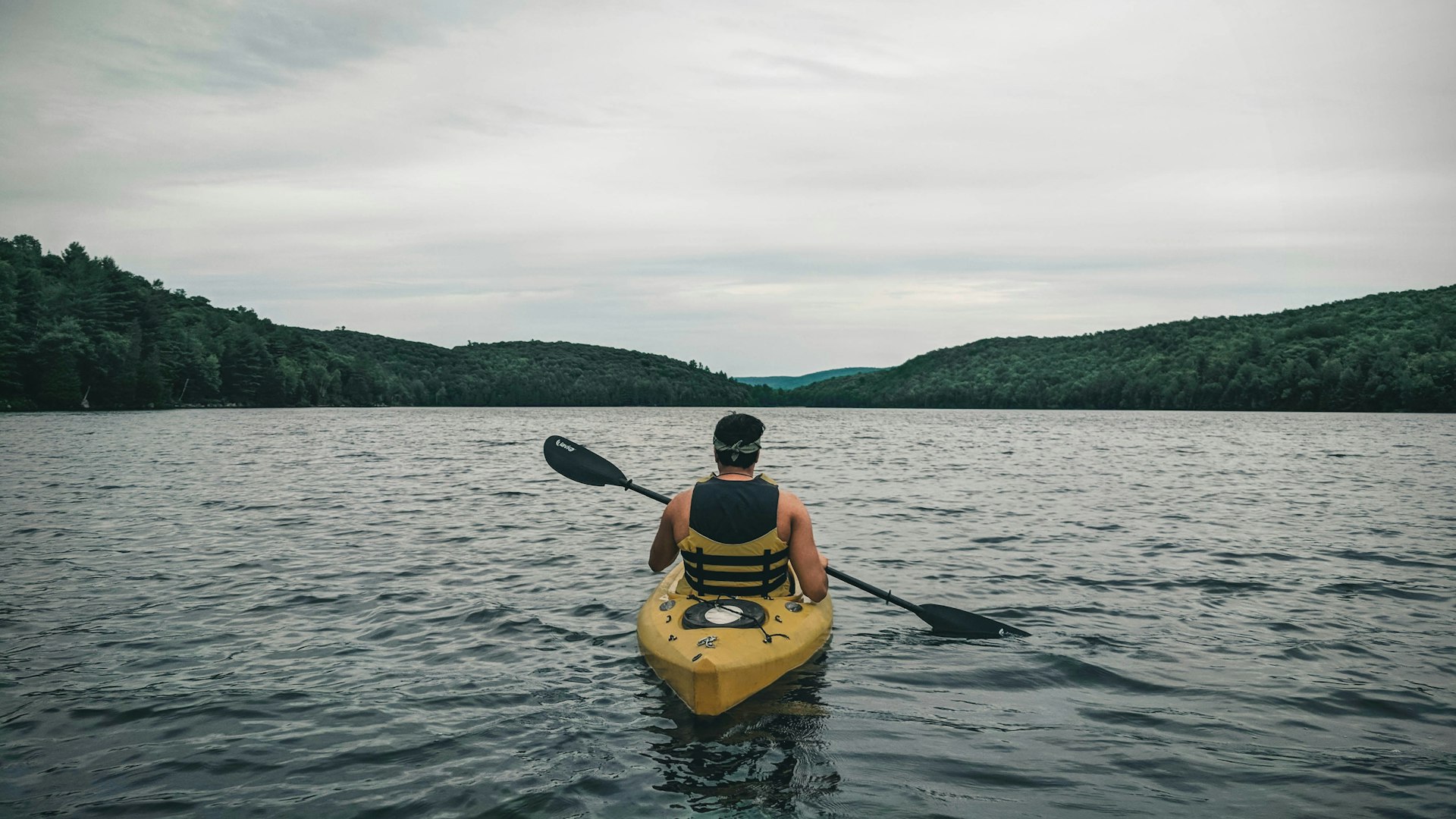
A canoe is an open boat that you sit up high or kneel in and paddle with a single-bladed paddle. A kayak sits lower in the water, is usually narrower, and is paddled with a double-bladed paddle. In practice, canoes carry more people, gear and dogs and are the classic choice for multi-day lake trips with portages. Kayaks are faster, handle wind and waves better, are easier to paddle alone, and suit day trips, coastal water and solo beginners.
Neither is harder to start in on calm water. The better boat depends on who’s coming, what you’re carrying, how far you’re going and what kind of water you’ll be on. Here’s how they compare.
Canoe vs kayak at a glance
| Canoe | Kayak | |
|---|---|---|
| Paddle | Single blade, one side at a time | Double blade, alternating sides |
| Seating | Raised seats or kneeling | Low seat, legs forward |
| Typical length | 15 to 17 feet for tandem boats | 9 to 12 feet recreational; 14 to 18 feet touring and sea |
| Typical weight | About 45 to 85 pounds depending on material | About 35 to 55 pounds recreational; touring varies |
| Cargo | High; open hull fits packs, coolers and barrels | Limited; gear goes in hatches or on deck |
| Best for | Families, dogs, lake trips with portages, calm rivers | Solo paddlers, fitness, coastal and windy water, day trips |
| Speed | Moderate | Faster for the same effort, especially touring kayaks |
| Learning curve | Steering takes practice (J-stroke) | Basic paddling comes quickly |
| Getting wet | Stays drier in calm water | Drips from the paddle; sit-on-tops are wet by design |
Dimensions and weights are typical ranges. They vary widely with design and material: aluminum and polyethylene boats are heavy and tough, while Kevlar and other composites are light and expensive.
Stability: which boat feels steadier
Stability depends more on the individual design than on whether it’s a canoe or a kayak. Wide boats feel steady when sitting still (primary stability). Narrow boats feel tippy at first but resist capsizing when leaned into waves (secondary stability).
- Recreational kayaks and sit-on-tops are wide and low. Most beginners feel secure in them within minutes.
- Canoes are stable as long as paddlers stay seated and centered. Standing up, reaching over the side or two people moving at once is how canoes tip.
- Sea and touring kayaks are narrow and feel unsteady on flat water, but handle chop and waves well in trained hands.
The US Coast Guard’s guide to federal boating requirements warns that canoes, kayaks and paddleboards tend to be less stable than larger boats and can capsize easily, and it asks paddlers whether they’ve practiced climbing back in with all their gear on. It’s a fair question for either boat.
Cargo and multi-day trips
This is the canoe’s biggest advantage. A 17-foot tandem canoe swallows two large portage packs, a food barrel, a cooler and a dog. That’s why the Boundary Waters in Minnesota and the canoe routes of Voyageurs National Park are canoe country: you carry the boat and packs over portages between lakes, and an open hull makes loading and unloading quick.
Kayaks carry less, packed into narrow hatches in small dry bags. Touring and sea kayaks still hold enough for several days, and they’re the standard for coastal trips such as the sea caves of Apostle Islands National Lakeshore or the islands of the Pacific Northwest, where speed, seaworthiness and a low profile in the wind matter more than volume. Some trips suit both: the 99-mile Wilderness Waterway in Everglades National Park is paddled by canoe and kayak alike.
For a first overnight trip on lakes, see how to plan your first canoe trip, and use the camping checklist for the gear.
Solo vs tandem
| Who’s paddling | Usually the better choice | Why |
|---|---|---|
| One adult | Solo kayak | Tracks straight, light to carry, easy to handle in wind |
| Two adults, day trip | Two kayaks or a tandem canoe | Kayaks give independence; a canoe keeps you together |
| Two adults, multi-day lake trip | Tandem canoe | Cargo space and easier portaging of one boat |
| Parent with a young child | Canoe or a tandem sit-on-top kayak | Child rides in the middle or front seat |
| Paddler with a dog | Canoe | Floor space for the dog to lie down |
Tandem kayaks exist, but they’re long and heavy, and the two paddlers must keep in rhythm to avoid clashing paddles. Solo canoes exist too, and are excellent, but a tandem canoe paddled alone is hard to control in wind unless you sit near the middle.
Learning curve and technique
Most people can paddle a recreational kayak in a straight line within a few minutes. The double-bladed paddle naturally alternates sides, so the boat doesn’t veer much. Learning to brace, edge and roll a sea kayak is a longer project best done with an instructor.
Canoes take a little more learning. Each paddler strokes on one side, which turns the boat away from that side. In a tandem canoe the stern paddler steers with the J-stroke, a small outward hook at the end of each stroke that keeps the canoe straight. Beginners often switch sides every few strokes instead, which works but tires you out and wobbles the boat. Half an hour of practice with the J-stroke near the launch makes the rest of the day much easier.
For moving water, both boats have specialized whitewater versions. If rapids are the goal, a guided raft trip is a good first step; see whitewater rafting for beginners.
Safety: life jackets, cold water and wind
Federal rules apply to canoes and kayaks as they do to other recreational boats. The Coast Guard requires a USCG-approved wearable life jacket for each person on board, and children under 13 must wear one while the boat is underway unless a state rule differs. Canoes and kayaks are exempt from the throwable flotation device required on other boats 16 feet and longer. Several states require paddlers to wear life jackets in cold months.
Paddling isn’t risk-free. According to the Coast Guard’s 2024 boating statistics, paddlecraft accounted for 26 percent of recreational boating deaths where vessel type was known: kayaks 16 percent, standup paddleboards 5 percent and canoes 4.5 percent. Where cause of death was known, 76 percent of victims drowned, and where life jacket use was known, 87 percent weren’t wearing one. The Coast Guard also points out that most boating drownings happen on nice days.
- Wear the life jacket, fastened. A jacket under the seat doesn’t help after a capsize. Paddling-specific jackets with large arm openings are comfortable all day.
- Respect cold water. The National Weather Service warns that cold shock from 50 to 60°F water can be as dangerous as from near-freezing water. Many northern lakes stay that cold into summer. Dress for the water temperature, not the air; see hypothermia signs and prevention.
- Watch the wind. Canoes sit high and catch wind; kayaks cope better but can still be blown offshore. Paddle early, hug the shore and avoid long crossings in the afternoon.
- Practice a capsize. Learn to get back in, or to swim the boat to shore, in warm, shallow water before you need to.
Cost, transport and storage
Prices vary with material and design. As of 2026, a basic recreational kayak typically costs a few hundred dollars, and touring and sea kayaks run from about $1,000 to over $3,000. Polyethylene and aluminum canoes commonly cost from several hundred dollars to around $1,500, and light composite canoes often start around $2,500. Paddles, life jackets and a roof rack add to the total.
Kayaks are easier to carry, car-top and store for one person. A 17-foot canoe usually needs two people to load, though solo carries with a yoke are a learnable skill on portages. Inflatable kayaks and canoes fold into a trunk and suit apartment dwellers, at some cost in speed and durability.
Anglers have both options: fishing kayaks with rod holders and stand-up decks, or canoes with room for a cooler and a partner. Remember that most states need you to hold a license whatever you fish from; see the fishing license guide. Many states also require registration once a canoe or kayak has any motor fitted.
Which one to choose
- Choose a canoe if you’ll paddle with a partner, kids or a dog, want to camp from the boat on lakes, need to portage, or want room for fishing gear and a cooler.
- Choose a kayak if you’ll often paddle alone, want exercise and speed, will be on the coast or big windy lakes, or have limited storage and car space.
- Rent both first. Most outfitters at lakes and parks rent canoes and kayaks by the hour or day. One afternoon in each tells you more than any comparison.
Sea kayaking also turns up on many expedition trips, from Alaska’s fjords to Antarctica; see expedition cruises for first-timers if that’s where you’re headed. For a first time out in either boat, pick a small, sheltered lake, go in the morning when it’s calm, wear the life jacket, and stay within an easy swim of shore until you’ve practiced getting back in.
Questions people ask
Is a canoe or kayak better for beginners?
For a solo beginner on calm water, a wide recreational kayak is usually easier: the double-bladed paddle keeps it straight without special strokes, and you sit low and stable. For two beginners, or a parent with kids, a canoe is often better because everyone fits in one boat and there's room for gear and snacks. Either way, start on a small, sheltered lake on a calm day and wear a life jacket.
Which is more stable, a canoe or a kayak?
It depends on the design more than the type. Wide recreational kayaks and sit-on-tops feel very stable because you sit close to the water. Canoes feel steady when paddlers stay seated and centered, but standing or leaning over the side tips them more easily. Long, narrow sea kayaks feel tippy at first yet handle waves well. The US Coast Guard notes that canoes and kayaks capsize more easily than larger boats.
Can you take a dog in a kayak?
Yes, in a stable sit-on-top or a large-cockpit recreational kayak, a small or calm dog can ride on your lap or on the deck. Canoes are much easier for dogs, especially medium and large ones, because there's floor space in the middle. Train the dog on land and in shallow water first, and put it in a dog life jacket with a grab handle so you can lift it back in.
Is a canoe or kayak better for fishing?
Both work. Sit-on-top fishing kayaks are popular for bass and coastal fishing because they're stable, have rod holders and let you stand on some models. Canoes carry more tackle and a cooler, fit two anglers, and can take a small electric trolling motor, which then counts as a motorboat for registration. Check your state's fishing license rules and any paddlecraft registration requirements.
How much does a canoe or kayak cost?
As of 2026, a basic recreational kayak typically costs a few hundred dollars and good touring or sea kayaks run from about $1,000 to over $3,000. Polyethylene and aluminum canoes commonly cost from several hundred to around $1,500, while light Kevlar or composite canoes often cost $2,500 or more. Add a paddle, life jacket and roof rack. Renting first is the cheapest way to decide.
Keep going
Next on the trail
Whitewater Rafting for Beginners: Rapid Classes, Costs and What to Expect
Whitewater rafting for beginners means Class II or III rapids with a licensed outfitter. Class II suits families and nervous first-timers, and…
Oct 6, 2026 · 7 min
How to Plan Your First Canoe Trip: Route, Permits, Gear and Safety
Plan your first canoe trip on flat water, such as the Boundary Waters in Minnesota or Algonquin in Ontario, for two or…
Oct 6, 2026 · 7 min
How to Choose a Canoe Paddle: Length, Bent vs Straight Shaft, Blades and Materials
To choose a canoe paddle, size it by your seated torso, not your height: sit on a flat chair and measure from…
Oct 13, 2026 · 8 min